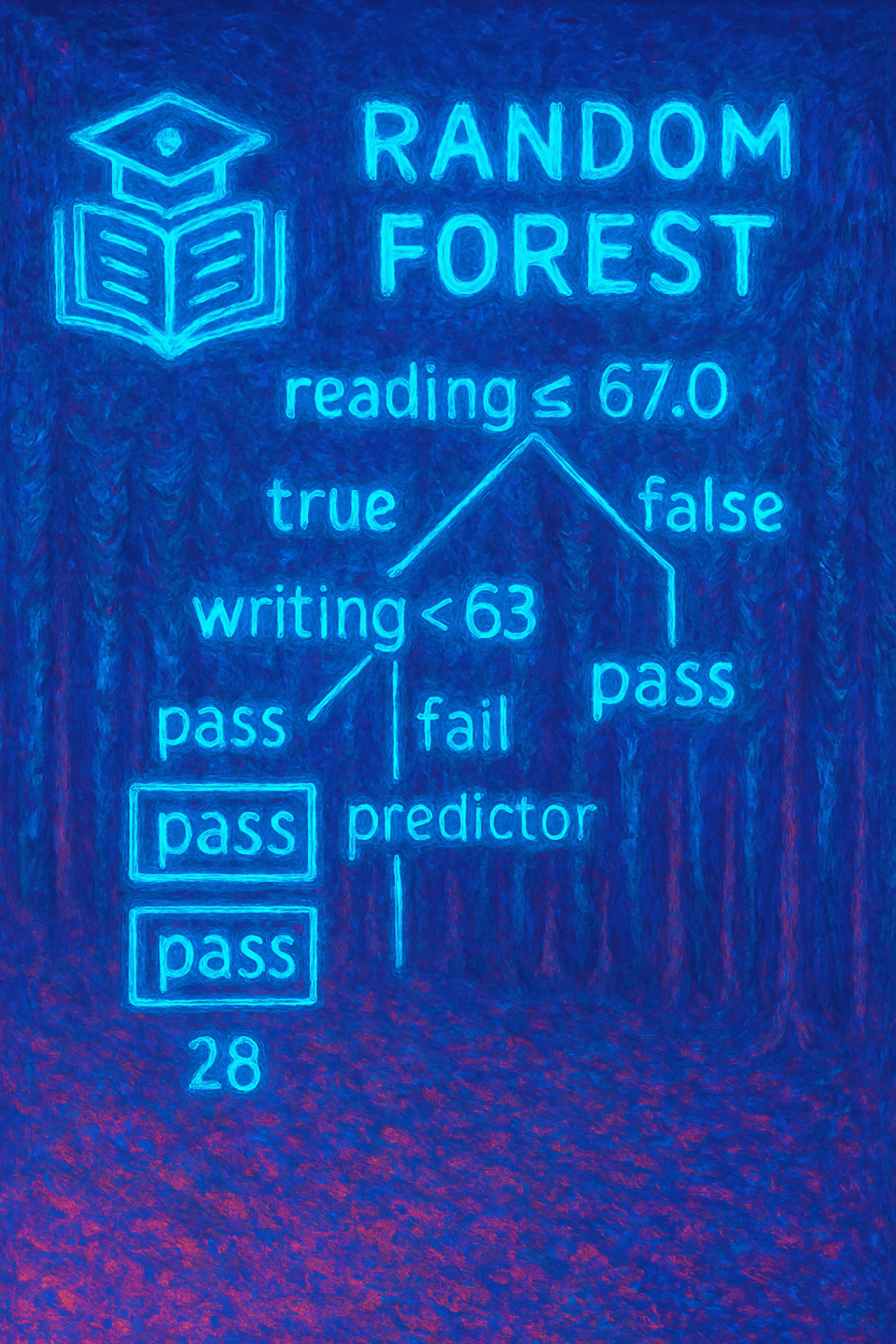


In today’s post, I’ll take an in-depth look at Random Forests, one of the most popular and effective algorithms in the data science toolkit. I’ll describe what I learned about how they work, their components and what makes them tick.
What Are Random Forests?
At its heart, a random forest is an ensemble of decision trees working together.
- Decision Trees: Each tree as a model that makes decisions by splitting data based on certain features.
- Ensemble Approach: Instead of relying on a single decision tree, a random forest builds many trees from bootstrapped samples of your data. The prediction from the forest is then derived by averaging (for regression) or taking a majority vote (for classification).
This approach reduces the variance typical of individual trees and builds a robust model that handles complex feature interactions with ease.
The Magic Behind the Method
1. Bootstrap Sampling
Each tree in the forest is trained on a different subset of data, selected with replacement. This process, known as bagging (Bootstrap Aggregating), means roughly 37% of your data isn’t used in any tree. This leftover data, the out-of-bag (OOB) set, can later be used to internally validate the model without needing a separate validation set.
2. Random Feature Selection
At every decision point within a tree, instead of considering every feature, the algorithm randomly selects a subset. This randomness:
- De-correlates Trees: Each tree becomes less alike, ensuring that the ensemble doesn’t overfit or lean too heavily on one feature.
- Reduces Variance: Averaging predictions across diverse trees smooths out misclassifications or prediction errors.
3. Aggregating Predictions
For classification tasks, each tree casts a vote for a class, and the class with the highest number of votes becomes the model’s prediction.
For regression tasks, predictions are averaged to produce a final value. This collective approach generally results in higher accuracy and more stable predictions.
Out-of-Bag (OOB) Error
An important feature of random forests is the OOB error estimate.
- What It Is: Each tree is trained on a bootstrap sample, leaving out a set of data that can serve as a mini-test set.
- Why It Counts: Aggregating predictions on these out-of-bag samples can offer an estimate of the model’s test error.
This feature can be really handy, especially when you’re working with limited data and want to avoid setting aside a large chunk of it for validation.
Feature Importance
Random forests don’t just predict, they can also help you understand your data:
- Mean Decrease in Impurity (MDI): This measure tallies how much each feature decreases impurity (based on measures like the Gini index) across all trees.
- Permutation Importance: By shuffling features and measuring the drop in accuracy the importance of a feature can be measured. This is meant to help when you need to interpret the model and communicate which features are most influential.
Pros and Cons
Advantages:
- Can handle Non-Linear Data: Naturally captures complex feature interactions.
- Can handle Noise & Outliers: Ensemble averaging minimizes overfitting.
- Doesn’t need a lot of Preprocessing: No need for extensive data scaling or transformation.
Disadvantages:
- Can be Memory Intensive: Storing hundreds of trees can be demanding.
- Slower than a single Tree: Compared to a single decision tree, the ensemble approach require more processing power.
- Harder to Interpret: The combination of multiple trees makes it harder to interpretability compared to individual trees.
Summary
Random Forests are a powerful next step in my journey. With their ability to reduce variance through ensemble learning and their built-in validation mechanisms like OOB error, they offer both performance and insight.
In my next post, I’ll share how I apply the Random Forest technique to this data set: https://www.kaggle.com/datasets/whenamancodes/students-performance-in-exams/data
– William
 William's Data Science Blog
Leave a comment